
Avian flu reports increasing in lower Treasure Valley
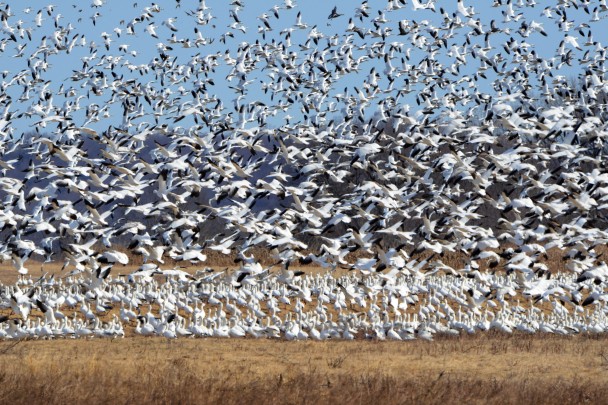
Although they aren’t considered massive die-offs, the Treasure Valley has seen some large numbers of avian flu related deaths among migratory birds in the lower Treasure Valley. IDFG asks that anyone discovering 20 or more dead birds to submit a report found at the IDFG website. Stock photo
By:
Nancy Grindstaff
Well into southwest Idaho’s waterfowl hunting season Idaho Fish and Game has reported a series of wild bird die-offs related to avian influenza in the Treasure Valley.
What was first identified as perhaps someone’s domestic duck found wandering around Park Intermediate School on Dec. 18, was later identified as a sick juvenile snow goose. The finding may be enough to warn area domestic bird and poultry owners to take precautions with their flocks, but since the disease is carried primarily by waterfowl, it is spread along their migratory paths.
According to a Dec. 11 F&G press release, personnel were aware of sick and dead wild geese reported in the Lake Lowell, Parma, and Fort Boise areas of the Treasure Valley, estimating the number of dead birds to be in the thousands.
On Thursday, Dec. 19, F&G regional communications manager Brian Pearson told the Signal American another mortality event had been reported in the intervening 8 days at the CJ Strike Wildlife Management Area.
“I think it was a couple of hundred birds out there,” Pearson said. “We have not confirmed through testing that it was avian influenza, but that is suspected.”
Pearson said, knowing avian influenza is present in the valley, the sick snow goose found at Park Intermediate School is the only individual bird he is aware of at this end of the valley, so far.
“The vast majority of these mortalities have occurred further down in the Treasure Valley,” he said.
“It’s primarily affecting juvenile birds, birds that were hatched this spring and they are thick on the wintering grounds. We know it’s here.
“What our wildlife health lab at this point is asking is if folks do find dead birds, to report that on our website, idfg.idaho.gov/wildlife-health,” Pearson said. “That is the reporting form and we’re really focused on areas where there are 20 or more birds found dead in an area, and particularly if those birds are found outside of Canyon County.”
Included in F&G’s Dec. 11 press release are the following recommendations:
Live birds showing signs of illness should be left alone. Local wildlife rehabilitation centers are not currently accepting wild birds. There is no treatment or vaccine for avian influenza and moving sick birds may spread it farther.
Dead birds can be disposed of in the trash to ensure other animals do not contact or consume them. The best practice when handling the birds is to use gloves and a mask, and place them in a double-bagged trash bag. People should also make sure to wash their hands after handling birds.
As the waterfowl hunting season continues into early January, a resource for hunters can be found at Hunters-Protect Your Poultry and Pet Birds from Avian Influenza (usda.gov).
Category:
 Español
Read Online E-Edition
Signal American
18 E. Idaho St.
Weiser, ID 83672
PH: (208) 549-1717
FAX: (208) 549-1718
Upcoming Events
-
10/24/2026 - 10:00am
-
10/27/2026 - 9:00pm
-
10/29/2026 - 9:00pm
-
11/03/2026 - 9:00pm
-
11/05/2026 - 9:00pm
Connect with Us

Signal American
P.O. Box 709 (18 E. Idaho St.) | Weiser, ID 83672
P.O. Box 709 (18 E. Idaho St.) | Weiser, ID 83672
